AI Pilots often fail. With no ROI. Last year, everybody wanted GenAI, now everyone wants something agentic. With no clue why, and whether is really a simplest solution for their problem. Pilots need a reality check, heck everyone needs a wake up call. AI needs to proof value to real users with real responsibilities in real workflows. That’s why I created this AI Ladder of Maturity to help you out!
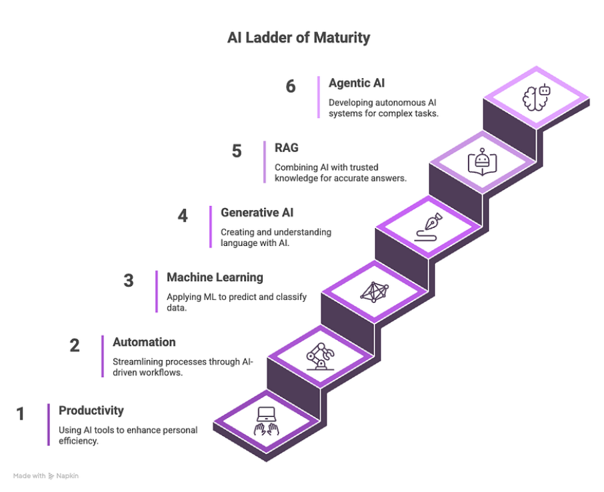
AI Ladder of Maturity: what type of solution is worth the investment and the risk
Why? It’s not because the technology isn’t good enough. It’s because we often fall for hype, reach for the wrong tools, or forget to ask the simplest question: Do we even need technology here?
This is the honest story of AI adoption: the messy, pragmatic, human story that rarely makes it into the glossy presentations.
At Sopra Steria, we help organisations get real value out of AI and data, responsibly and at large scale. As an European top-5 tech player, our AI approach balances human-first and value-driven, delivers value with production-ready AI products and services, and ensures trustworthy sustainable scale up with technology as sovereign as possible. By listening to people, we help break down complexity and add AI only in ways that it adds value. We make our impact measurable and build production-ready and modular. With our deep domain expertise, we understand the challenges of our clients and take responsibility to solve these. Always compliant, with clear governance, and the operating model to scale up.
At Sopra Steria, our AI approach balances human-first and value-driven, delivers value with production-ready AI products and services, and ensures trustworthy sustainable scaleup with technology as sovereign as possible.
Before reading any further, let me give you some advice. Before you build an AI solution, answer these three questions:
- For who, does this create what value and what do they need to benefit from this value?
- What risks and complexity does your AI solution bring and is there a simpler alternative?
- How will we prove your AI solution works in production and will keep working?
We’ve developed the AI Ladder of Maturity to help you navigate the AI hype. We are eager to hear your thoughts!
When a Hammer Will Do
Picture this: you want to hang a painting. Do you really need a robot with laser precision or just a hammer and a nail?
In AI, too often we reach for the robot. Fancy generative AI models, shiny agentic AI systems, or endless PoCs (proofs of concept). Meanwhile, the actual problem could have been solved with:
- Training people to use a tool better.
- Changing a broken process.
- Adding a simple automation step.
AI is not a magic wand, although it can be amazing when applied when the value outweighs the risks plus the investment. Sometimes, the hammer really is enough.
The AI Ladder of Maturity
To avoid overengineering, it helps to think in maturity levels — a practical ladder of solutions, where each step builds on proven value from the previous one. For every problem, pick the right step of the ladder.
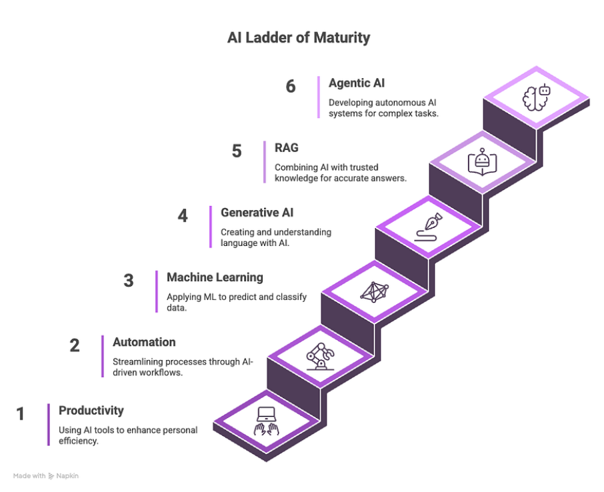
AI Ladder of Maturity: Picking the Right Tool for the Right Job
1. Productivity: Using AI to Work Smarter
This is the foundation. Employees use AI tools — like Microsoft Copilot, ChatGPT, or Notion AI — to improve personal productivity: drafting emails, summarising documents, generating ideas.
How much value you get here depends on AI literacy: knowing how to prompt effectively, validate outputs, and use AI responsibly.
For most organisations, this stage alone already yields measurable gains.
2. Automation: Simplifying Processes
Once individuals become productive, look at processes. Where can we eliminate repetitive steps through workflow automation, scripts, or simple bots? This reduces manual work and creates consistency. And, even better, dare to redesign the whole workflow!
3. Machine Learning (ML): Learning from Data
When data can improve decisions, ML comes in. It predicts, classifies, detects patterns — like forecasting demand or identifying fraud. Proven, reliable, and well-understood.
4. Generative AI (GenAI, LLMs): Creating and Understanding Language
GenAI models can summarise, write, and converse. Perfect for drafting marketing copy or helping support teams. But beware of hallucinations and lack of precision — use it where creativity and speed matter more than factual accuracy.
5. RAG (Retrieval-Augmented Generation): Combining AI with Trusted Knowledge
RAG enriches GenAI with the context of your own data — documents, manuals, or databases — so it can answer accurately within your domain. Also, you may have heard of advanced RAG variants like GraphRAG or modularRAG (RAG Flow) that make knowledge structured, trustworthy, and reusable for both man and machine. These advanced RAG variants are often needed to optimise for the downsides of naive RAG approaches and make it production ready.
6. Agentic AI: The Emerging Frontier
And finally, the top of the ladder — the one everyone’s talking about. AgenticAI refers to systems that can plan, reason, and act autonomously, often coordinating multiple AIs to complete complex tasks.
The potential is huge. But today, Agentic AI is production-ready only in constrained, well-governed scenarios. High autonomy use cases remain risky and require strong oversight. We are helping our clients to build reliable Agentic AI systems, train their users and reshape their operating models. In order to make sure they can rely on Agentic AI in production.
So, wait before you rush to the top. The point is not to climb as high as possible, but to pick the simplest tool that delivers the outcome. Real value comes from maturity — not from hype.
Sometimes the Answer Is: No Tech at All
Here’s the question we don’t ask often enough: Is technology even the answer?
Take an onboarding process in HR. Do you really need a chatbot with natural language understanding? Or would updating the onboarding guide and training managers solve 80% of the pain?
It’s tempting to throw AI at every problem. But sometimes, non-technical solutions are faster, cheaper, andmore human. That’s also part of AI without the hype.
The European Angle: Sovereignty and Trust
Working with European organisations, another challenge emerges: sovereignty.
Big tech and hyperscalers (Google, Microsoft, Amazon) offer impressive tools. But they often lack:
- Local compliance guarantees.
- Domain-specific expertise.
- Real-time or non-public knowledge.
- Proof of value by evaluating the performance.
That’s why many European organisations prefer European providers. The only way to make smart choices is through rigorous evaluation andbenchmarking. Test results, compare options, and design your architecture to switch providers if needed. Flexibility is a strategy in itself.
Frugal AI: Less Is More
Not every solution needs the biggest model or the most compute. Sometimes a smaller, fine-tuned, open-source model works almost as well. It is important to evaluate whether this is true for your use case, based on metrics like accuracy, latency, cost per task, energy use, hallucination rate, user satisfaction, compliance risk, etc.
Thisis frugalAI — doing more with less. It’s not just about cost savings, but also sustainability and resilience.
Yes, it takes extra effort:
- Safeguarding performance.
- Monitoring accuracy.
- Optimising over time.
But in return, you get AI that’s lean, adaptable, and easier to trust. With the hype of Agentic AI, this becomes more important. Like the cloud hype earlier, after the first quick adoption the cloud cost exploded. The same will happen with agentic AI, since the tokens used and thus the cost and footprint will exponentially grow when not managed.
The solution here also lies in measuring theperformance. Can we use a smaller cheaper model for this task? Is the performance still good enough? What settings can we change to optimise the performance? This approach makes for a future-proof AI strategy, because when newer models come out, you will have the evaluation pipelines in place to test whether a newer model is suited for your use case.
We see that most organisations need to create ground-truthdatasets with examples of input and output for a task, and describe the task in detail, like you would to a colleague. Then, with the right metrics for the task, you can find the optimal instruction and settings to perform the task with LLMs.
Adoption Is Human
The biggest myth? That AI adoption is a tech challenge. It isn’t. It’s a change management challenge.
- If employees don’t trust the model, they won’t use it. If they overtrust, critical thinking goes overboard.
- If leaders don’t support adoption, pilots stay in the lab. This requires literacy, boldness and C-level attention. Also, the right change story is important, because some people are scared for their job.
- If processes don’t adapt, AI creates friction instead of value. Dare to reinvent the process, not optimise a broken process.
Successful AI projects are 50% about models and infrastructure — and 50% about communication, training, and governance. Without the latter, the former is wasted effort. And don’t forget, most new habits take about 60 days to internalise. So it is all about thefollow-up, not the one big bang release and training.
Practical Next Steps
If you want your AI pilot to survive, here are a few questions to ask before you start:
- Problemfit: What are the most important problems to solve? Could this be solved with training, process redesign, or automation instead? What is the value of solving this problem?
- Tool fit: What is the best solution for this problem?What’s the least complex technology that could deliver value?
- Adoption fit: How will people trust and embrace the solution? Do they have enough AI literacy for the execution?
- Provider fit: Do we need European sovereignty or flexibility to switch providers? Do we know exactly the requirements we want to hold our partner to?
- Sustainabilityfit: Could a smaller model work just as well? How do we measure and evaluate the performance and the value? What is good enough value to go to production?
If you can’t answer these questions upfront, don’t start your pilot!
Closing Thought
AI adoption doesn’t fail because of lack of tech. It fails because we overcomplicate, overhype, and overlook the human side.
The winners will be those who:
- Cut through the hype, find the problems where the risk is worth solving with AI and balance portfolio with 80% proven tech and 20% emerging tech.
- Choose the right tool for the job, keep it simple and only apply AI when it adds value.
- Balance ambition with pragmatism and prioritise AI efforts based on value and investment. Start with low-hanging fruit to create momentum and follow-up with harder high value use cases.
- Keep humans — not algorithms — at the center, focus on change management and user adoption. Start with listening.
That’s what it means to do AI without the hype.
The world is how we shape it, value-driven, human-first and driven by AI, while we protect what is precious — Sopra Steria